

Learn the full AI stack.
From energy infrastructure to the apps that run on it — structured learning for curious humans.
AI is everywhere. Understanding how it actually works shouldn’t require a computer science degree or a tolerance for hype. Kindling organizes the entire landscape into five clear layers, so you can start anywhere and build a real mental model.The AI Technology Stack
Modern AI isn’t one thing — it’s a layered system where each level depends entirely on the one below it. NVIDIA’s Jensen Huang popularized this framing at CES 2026. We use it as Kindling’s organizing principle because it works: once you see the stack, the whole industry starts to make sense.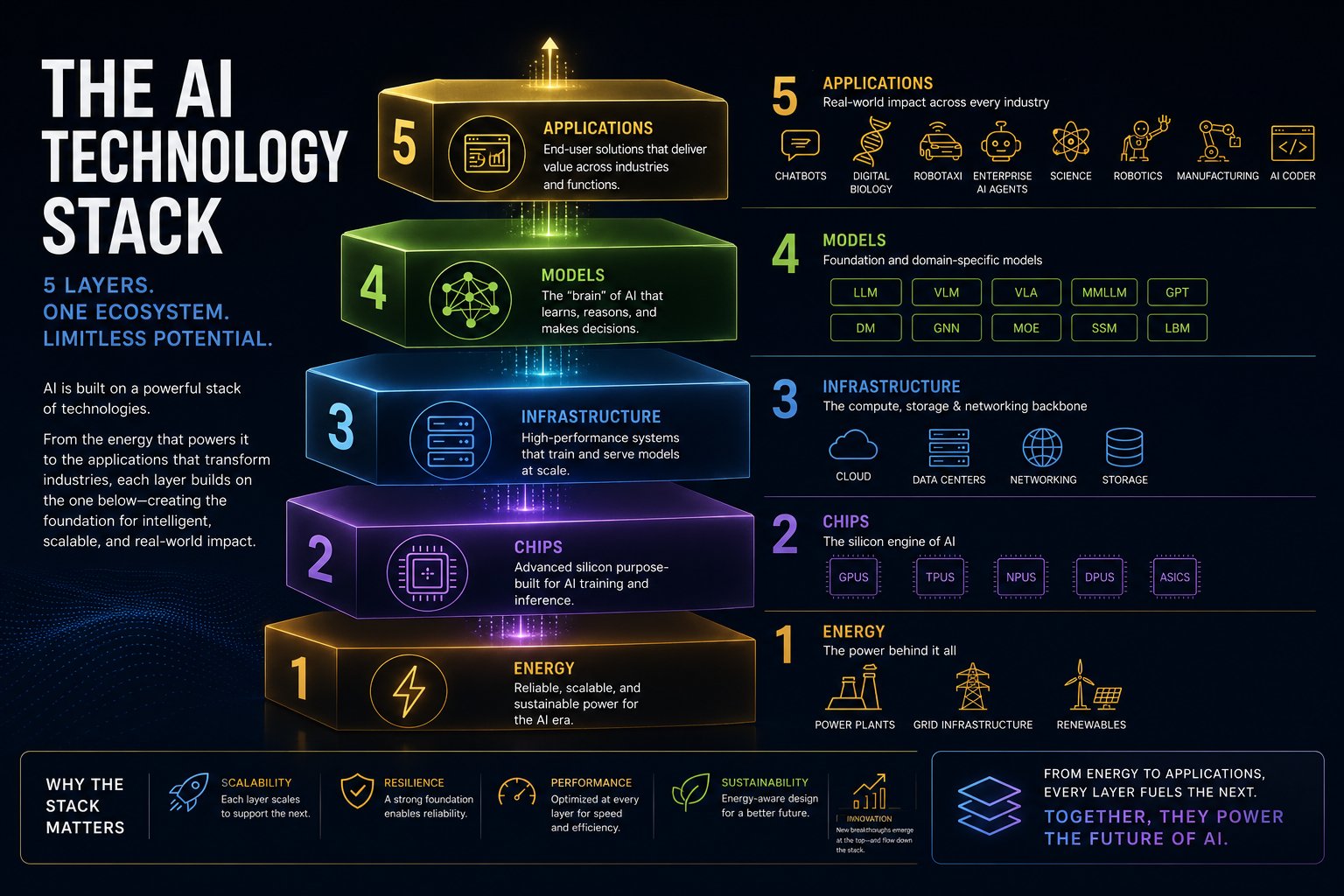
The AI Technology Stack — five interdependent layers from energy to applications. Source: NVIDIA / Jensen Huang, CES 2026.
5 · Applications
What people actually use. Chatbots, coding assistants, autonomous agents, retrieval-augmented generation (RAG) systems, multimodal apps — all products built on the layers below. This is where AI creates tangible value, and where most of the innovation you read about is happening. Understanding what’s beneath helps you build better here.
4 · Models
The intelligence itself. Foundation models are trained on vast datasets and develop a compressed, statistical understanding of language, images, code, and more. That understanding lives in billions of numerical parameters called weights. Fine-tuning, RLHF, and prompt engineering are all techniques for shaping what a model knows and how it behaves — without retraining from scratch.
3 · Infrastructure
Models don’t run themselves. Infrastructure is the software layer that orchestrates compute at scale — cloud providers like AWS, Azure, and GCP; model-serving frameworks; vector databases; orchestration tools; and the APIs that connect it all into reliable services. This is where AI goes from “a GPU in a rack” to “something a million people can call simultaneously.”
2 · Chips
The raw computation happens on specialized silicon. GPUs — originally designed for rendering game graphics — turned out to be ideal for the matrix math that underlies neural networks. The result is a global arms race in accelerator hardware: NVIDIA, AMD, Google (TPUs), and dozens of startups. The chips available at a given moment define what models are possible to train and what it costs to run them.
1 · Energy
The physical foundation. Training a frontier model can consume as much electricity as thousands of homes. Inference runs continuously at data centers around the world. Energy isn’t a footnote in AI — it’s a hard constraint shaping where and how fast the technology can grow. Data centers are being built next to power plants, in remote regions, and increasingly powered by dedicated nuclear reactors.
Why start from the top? Most people encounter AI through applications — a chatbot, a coding tool, an image generator. Starting at layer 5 and working down lets you trace what you already know back to its roots. By the time you reach energy, you’ll see why it matters.
Start exploring
Library
A curated catalog of AI tools, repos, and reading material — organized by function, not hype.
Applications
Agents, RAG systems, coding assistants, and the products built on the stack.
Models
Foundation models, weights, fine-tuning, and how language models actually work.
Infrastructure
Cloud APIs, orchestration, vector databases, and model serving at scale.
Chips
GPUs, TPUs, custom accelerators, and the silicon arms race powering AI.
Energy
Data centers, power grids, and the physical infrastructure sustaining AI at scale.
About Kindling
Kindling is a project by TumbleweedLabs — built to make the AI stack learnable and approachable for everyone, regardless of background. The goal is structured, honest material that respects your intelligence without assuming you already have a PhD.